You are about to clean a part at the parts washer, a shop sink that pumps solvent over dirty parts. Its solvent is Safety-Kleen MIL-PD-680, TYPE II Solvent, a dry cleaning solvent. You pull on whatever gloves are on the supply cart and never open the safety data sheet (SDS) for the solvent.
The sheet tells you what protection the job needs, and a glove of the wrong material can let a chemical through to your skin.
Cart
Where the gloves came from
Picked up without reading the sheet.
Section 8
Where you check first
The part of the sheet that covers gloves.
Safety data sheet (SDS)
The document a chemical manufacturer supplies with each hazardous chemical, which is a chemical that can cause a fire, an injury or a health problem. It lists the hazards, protective equipment, first aid, spill response, storage and disposal.
Solvent
A liquid that dissolves or removes grease, oil or paint.
Learning Objectives
When you finish this lesson you can do the four things below. The check at the end asks about each of them.
1ExplainExplain why every safety data sheet has the same 16 sections in the same order, and who must be able to reach the sheet during a shift.
2FindFind first aid, spill response, storage, protective equipment (gloves, goggles) and disposal on a sheet by section number.
3ChooseChoose gloves from Section 8 of the sheet instead of from the cart.
4LabelLabel a secondary container, which is any container you fill from the original, so that the label still points back to its sheet.
Key Facts
16 sections
Every sheet uses the same order, and a copy must be within reach during every shift.
5 sections
Sections 4, 6, 7, 8 and 13 answer first aid, spills, storage, protective equipment and disposal.
Section 8
Match the glove material it names to the glove box. If it names none, ask your supervisor.
Container label
A container you fill carries the product name and the hazard warnings.
Lecture Video
Watch the lecture. Continue appears when it ends. You can skip it for now and reopen it from this page later.
Unmarked Container
You may have seen an unmarked bottle in a garage or a shop. Choose what you would do.
FIG 1 A squeeze bottle of clear liquid with no label.
Quick recall
You find an unmarked squeeze bottle of clear liquid on a shelf. What do you do?
16 sections
Standard Format of the Safety Data Sheet
Every safety data sheet has the same 16 sections in the same order. First aid is Section 4 on every sheet, so you can go straight to it without searching.
Safety data sheet directory
Select a section to see what it contains. Sections with an amber edge are the ones used most often on the job.
Select a section to see what it contains.
The Occupational Safety and Health Administration (OSHA), the US workplace safety agency, requires the same 16 sections in the same order on every sheet.
Source: OSHA Hazard Communication Standard (revised in 2012 and updated in 2024), Title 29 of the Code of Federal Regulations (CFR), section 1910.1200(g)(2).
Check your understanding
A manufacturer's sheet puts first aid at Section 6 and disposal at Section 9 because the manufacturer thinks it reads better. What is wrong with that sheet?
Sections 4, 6, 7, 8 and 13
Sections Used Most Often
Five sections answer most of the questions you have on the job: first aid, spills, storage, protective equipment and disposal.
Exposure
Contact with a chemical: on the skin, in the eyes, by breathing it or by swallowing it.
Personal protective equipment (PPE)
The gear you wear to protect your body from a hazard, such as gloves and goggles.
4
First-aid measures
Read it for what to do right away after an exposure. First aid does not replace medical care.
6
Accidental release measures
Read it for how to contain and clean up a spill.
7
Handling and storage
Read it for how to handle the product and what to keep it away from.
8
Exposure controls and personal protection
Read it for which gloves, eye protection and ventilation (fresh air moved through the work area) to use.
13
Disposal considerations
Read it for how to dispose of leftover product and wet rags. They may be hazardous waste, which is waste that must not go in ordinary trash or down a drain. Follow the sheet and your shop's waste procedure.
When Each Section Is Used
Before you start
Storing the product and choosing protective gear.
Tap the bucket where the card belongs. On a computer you can also drag the card.
An exposure or a spill
First aid and cleanup.
After the job
Leftovers and waste.
Which bucket does this card belong in?
Terms on the Sheet
The next page is the real safety data sheet for the parts washer solvent, in the manufacturer's own words. These are the words on it that you may not know yet, listed by the section they are in.
1Section 1, Identification
Synonyms
Other names for the same product.
Degreasing
Removing grease and oil from a part.
Dry cleaning solvent
A solvent made from crude oil (petroleum) that removes grease, oil and light dirt, also called Stoddard solvent.
Federal Commercial Item Description
A description the US government writes of a product it buys: A-A-59601A describes dry cleaning and degreasing solvent, PD680, and Type II is one kind of it.
2Section 2, Hazard identification
GHS
The Globally Harmonized System, the worldwide system of hazard symbols and warnings that OSHA follows.
Hazard pictogram
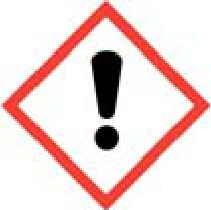
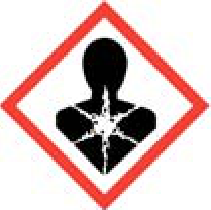
A GHS hazard symbol in a red-bordered diamond, known by its code: GHS07 is the exclamation mark and GHS08 is the health hazard symbol.
Signal word
One word that shows how severe the hazard is: Danger for the more severe hazards and Warning for the less severe.
H number
The code of a hazard statement, which is a short standard warning, such as H227, Combustible liquid.
P number
The code of a precautionary statement, which is a short standard instruction for preventing harm, such as P210.
Combustible liquid
A liquid that burns, but gives off enough vapor to catch fire only when it is heated well above room temperature.
Enters airways
Gets into the windpipe and the lungs, which can happen while the liquid is swallowed or when the person vomits.
Ignition source
Anything that can start a fire, such as a flame, a spark or a hot surface.
3Section 3, Composition and ingredients
Petroleum distillates, hydrotreated light
The ingredient of this solvent: a liquid distilled from crude oil (petroleum), which means boiled off and cooled back into a liquid, and then treated with hydrogen.
Percent by weight
How much of the product's weight is this ingredient: the sheet gives a range, 60 to 100 percent, because the manufacturer keeps the exact amount a trade secret.
4Section 4, First-aid measures
Inhalation
Breathing a chemical in, as a vapor, a mist or a spray. Vapor is the gas a liquid gives off.
Ingestion
Swallowing a chemical. Do NOT induce vomiting means do not make the person throw up.
Contaminated
Having the chemical on it or soaked into it.
Poison center
A phone service staffed by poison experts who tell you what to do after someone swallows or is exposed to a poison.
5Section 5, Fire-fighting measures
Vapor-air mixture
Vapor from the liquid mixed with air, which can burn or explode when it meets an ignition source.
Extinguishing media
The materials used to put out a fire, such as water, foam or dry chemical powder, and unsuitable media must not be used on this product.
6Section 6, Accidental release measures
Absorbent
A material that soaks up a spilled liquid, such as pads, socks or clay granules.
Dike
A low barrier, such as absorbent socks laid around a spill, that keeps the liquid from spreading. The sheet calls the spreading migration.
Inert material
A material that does not burn and does not react with the chemical, such as sand or clay absorbent.
Non-sparking tool
A tool made of a metal, such as brass, that does not throw a spark when it strikes something.
7Section 7, Handling and storage
Incompatible materials
Chemicals that must be kept away from the product because they can react with it dangerously.
Oxidizer
A chemical that helps other materials burn, often by giving off oxygen.
Strong acids and strong bases
Chemicals that attack skin and metal, such as battery acid (an acid) and lye (a base).
Residual vapors
Vapor left in a container after the liquid is gone.
8Section 8, Exposure controls and personal protection
Chemically resistant
Made of a material that holds up to the chemical without breaking down or letting it through.
Side shields
Pieces on the sides of safety glasses that protect the eyes from splashes and flying bits that come from the side.
Respiratory protection
A respirator, which is a mask that filters the air you breathe or supplies clean air.
9Section 9, Physical and chemical properties
Flash point
The lowest temperature at which a liquid gives off enough vapor to ignite, given on this sheet in degrees Celsius (°C) and degrees Fahrenheit (°F).
10Section 10, Stability and reactivity
Stability and reactivity
Stability is whether the product stays the same in storage, and reactivity is how easily it changes when it meets another chemical.
11Section 11, Toxicological information
Prolonged exposure
Contact with the chemical that lasts a long time or happens again and again.
14Section 14, Transport information
Identification number
The number that marks a hazardous material for shipping under US Department of Transportation (DOT) rules, and NA1993 marks this solvent as a combustible liquid.
15Section 15, Regulatory information
TSCA inventory
The list of chemicals made or used in the United States that the Environmental Protection Agency (EPA) keeps under the Toxic Substances Control Act, a federal law.
16Section 16, Other information
OSHA Hazard Communication Standard
The OSHA rule, 29 CFR 1910.1200, that requires safety data sheets, container labels and training for hazardous chemicals.
Reading the Sheet
This is the safety data sheet for Safety-Kleen MIL-PD-680, TYPE II Solvent, the parts washer solvent from the first page. Each section shows the sheet's own words, shortened where the sheet is long. Under each section you can open that page of the real sheet.
A container label is the short version of the sheet. It carries the product name, a signal word, symbols, short warnings and short precautions such as wear protective gloves. Section 2 of the sheet lists these label elements. The details you act on, such as the rinse time, the storage rules and the disposal route, are in the other sections.
Product name
The name of the chemical, printed on the container. It matches Section 1 of the sheet, and it is how you find the right sheet.
Signal word
One word that shows how severe the hazard is. Danger is used for the more severe hazards and Warning for the less severe.
Short warnings
Brief statements of the main hazards, such as Combustible liquid. The sheet calls them hazard statements.
Label Elements of the Parts Washer Solvent
Section 2 of the sheet for Safety-Kleen MIL-PD-680, TYPE II Solvent gives these label elements. Each hazard statement has an H number and each precaution a P number. The symbols are GHS pictograms. GHS is the Globally Harmonized System, the worldwide system of hazard symbols and warnings that OSHA follows.
Symbols
GHS07 Exclamation markGHS08 Health hazard
Signal word
Danger
Hazard statements
H227Combustible liquid.
H304May be fatal if swallowed and enters airways.
H336May cause drowsiness or dizziness.
Two of the precautions
P210Keep away from heat, hot surfaces, sparks, open flames and other ignition sources. No smoking.
P280Wear protective gloves, protective clothing, and eye protection.
Safety-Kleen MIL-PD-680, TYPE II Solvent Safety Data Sheet, SDS No. 82889, revised 02/24/2022. Used for training.
The Risk Diamond
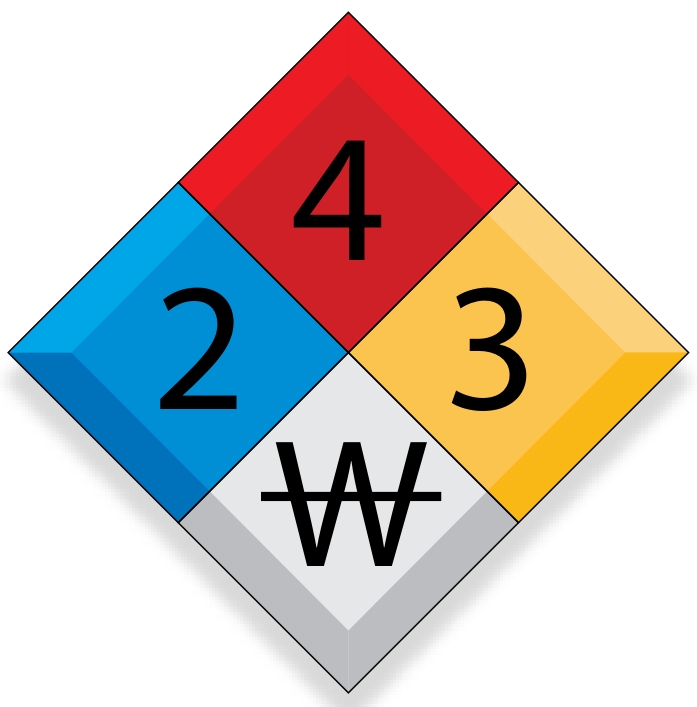
Some containers also carry a risk diamond, which the Federal Aviation Administration (FAA) Aviation Maintenance Technician Handbook describes. It is a four-color diamond. Select each color to see what it shows.
Select a color on the diamond.
0Little or no hazard
1
2
3
4Very hazardous
This diamond shows a material that is very flammable (4), in the middle of the scale for health (2), high for reactivity (3), and that reacts with water (the W with a line). Source: FAA-H-8083-30B, Aviation Maintenance Technician Handbook, General, Figure 1-2.
Diamond of the Parts Washer Solvent
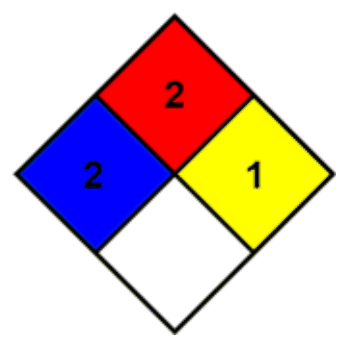
Section 16 of the sheet for Safety-Kleen MIL-PD-680, TYPE II Solvent gives the solvent's own numbers and draws its diamond. The sheet calls them NFPA ratings. NFPA is the National Fire Protection Association, the group that sets the diamond's scale. The special hazard square is empty.
The diamond drawn in Section 16 of the sheet.
2
Health
Under emergency conditions it can leave a person unable to act for a time, or cause a lasting injury.
2
Fire
It must be moderately heated, or kept where the air is quite hot, before it will ignite.
1
Reactivity
It is normally stable, but can become unstable at high temperature and pressure.
Safety-Kleen MIL-PD-680, TYPE II Solvent Safety Data Sheet, SDS No. 82889, revised 02/24/2022. Used for training.
The diamond is a quick check. By itself it does not tell you which gloves to wear or give first aid. Those answers are on the sheet.
Secondary Containers
A secondary container is any container you fill from the original container, such as a squeeze bottle or a wipe dispenser filled from a can. The label on the original container stays on that container, so the new container needs its own label.
Label a secondary container with the product name, exactly as it is on the original container, and with words, pictures or symbols that warn of the hazards.
Product name
The same name that is on the original container and in Section 1 of the sheet. A general word such as Solvent does not identify the product, and neither does a nickname.
Hazard warnings
Words, pictures or symbols that give at least general information about the hazards, such as Combustible liquid. Copy the main warnings from the original label.
The one exception is a container that you fill, that only you use, and that you finish with in the same work shift. If anyone else may use it, or it stays past your shift, it needs a label. When you are not sure, label it.
WarningDo not store a chemical in a food or drink container. Someone may drink from it.
Labeling a Container
Access to the Sheet
Every employee who works with a hazardous chemical must be able to reach its safety data sheet during the shift, in the work area, without asking permission and without waiting.
SDS binder, open bracket, no lock and no sign-out.
Eyewash, basin clear.
Emergency phone.
Computer with the sheets.
Printed copy beside the computer, the backup for a power or network failure.
FIG 2 A shop SDS station: a labeled binder in an open wall bracket beside the eyewash (a fixture for rinsing the eyes) and the emergency phone, with a computer for electronic access and a printed copy beside it as the backup.
OSHA requires that employees can reach the sheet in their work areas during each shift. Electronic access is allowed. If the sheets are kept on a computer, the shop also needs a backup, such as a printed copy, for when the power or the network fails.
Access Arrangements
Meets the requirement
Employees on every shift can reach the sheet.
Tap the bucket where the card belongs. On a computer you can also drag the card.
Does not meet it
Someone cannot reach the sheet, or a lock or a sign-out blocks it.
Which bucket does this card belong in?
Missing Sheet Procedure
Do not use the product.
Tell your supervisor that the sheet is missing.
Wait for the sheet. The employer must get it from the manufacturer or the supplier.
Protective equipment
Glove Materials
Disposable and reusable gloves are made from different materials, and each material resists some chemicals and fails against others. When a sheet names a glove material, that is the name you look for on the glove box. These are four materials you will see in the shop.
Four glove materials
Select a card to turn it over.
The same glove can protect against one chemical and fail against another.
Protective equipment
Selecting Gloves
A supply cart is usually stocked with gloves for general jobs. The glove for a chemical is chosen from Section 8 of that chemical's sheet, before you start. Some sheets name a glove material. Others, like the sheet for the parts washer solvent, say to wear protective gloves but name no material.
FIG 3 What to do with the hand protection line in Section 8. The parts washer solvent's sheet names no glove material, so it takes the No path.
READ SECTION 8 BEFORE YOU START. IF IT DOES NOT NAME A GLOVE MATERIAL, ASK YOUR SUPERVISOR.
The five steps
1Name the chemical exactly as the container names it.
You find a sheet by its product name. The name on the container is the name on the sheet, in Section 1.
2Open Section 8 of that chemical's sheet.
Section 8 is exposure controls and personal protection. It lists the gloves, the eye protection and the ventilation.
3Read the hand protection line.
Some sheets name a glove material. They may also give a thickness or how long the glove lasts against the chemical, and you follow all of it. Other sheets say only to wear protective gloves.
4If the sheet names a material, find it on the glove box.
Read the label on the box. The color of a glove does not identify its material, because gloves of different materials can be the same color.
5If no material is named, or the right gloves are not here, stop and ask.
Ask your supervisor which glove to use for this chemical, or where the right gloves are kept. Do not guess and do not substitute another glove.
Do all five steps before you start the job.
Protective equipment
Permeation
A glove can protect against one chemical and fail against another even when it has no hole, because a chemical can pass through the glove material itself.
Permeation
The passage of a chemical through a glove material, even when the glove has no hole or tear.
Breakthrough time
The time a chemical takes to pass through the glove material and reach the inside. Glove manufacturers list it for many chemicals, and some sheets list it in Section 8.
Unnamed Glove Material
The hand protection line in Section 8 of the parts washer solvent's sheet says only: Wear protective gloves. The only gloves in the work area are thin vinyl gloves. What do you do?
Inside the Glove
1Soaks in.
The chemical soaks into the outside surface of the glove.
2Spreads through.
It spreads through the thickness of the glove material.
3Comes out.
It comes out on the inside surface, against the skin.
Swelling is one sign that a glove is failing, and some materials also stiffen or soften. A chemical can also pass through a glove with no visible change. Keeping the chemical against the skin can lengthen the exposure. Bare hands are not the answer. Use the material the sheet names, or the glove your supervisor names when the sheet names none.
Solvents on Aircraft
The Federal Aviation Administration (FAA) Aviation Maintenance Technician Handbook names dry cleaning solvent, also called Stoddard solvent, as the most common petroleum-based cleaning solvent used on aircraft. It removes grease, oil and light dirt. The parts washer solvent is this kind of solvent: Section 1 of its sheet says it meets the federal description for Dry Cleaning and Degreasing Solvent, PD680, Type II.
Flash point
The lowest temperature, in degrees Fahrenheit (°F), at which a liquid gives off enough vapor to ignite. The lower the flash point, the more easily the liquid ignites.
Class I flammable liquid
A flammable liquid with a flash point below 100 °F. The handbook calls these low flash point liquids.
152.6 °F
Parts washer solvent, flash point
Section 9 of its sheet: 67 °C (152.6 °F).
Below 0 °F
Acetone, flash point
It is a Class I liquid. The handbook says not to use Class I liquids to clean aircraft.
The handbook gives dry cleaning solvent a flash point slightly above 105 °F. The sheet for this Type II product gives 152.6 °F, so read the flash point on the sheet for the product in your hand.
In a shop at room temperature, acetone already gives off enough vapor to ignite. Dry cleaning solvent does not give off that much vapor until it is heated to its flash point. It is still a fire hazard. Section 5 of the parts washer solvent's sheet says: Combustible liquid. May form flammable or explosive vapor-air mixture.
Section 2 of the parts washer solvent's sheet
P210 Keep away from heat, hot surfaces, sparks, open flames and other ignition sources. No smoking.
Sources: FAA-H-8083-30B, Aviation Maintenance Technician Handbook, General, Chapter 8, Aircraft Cleaning. Safety-Kleen MIL-PD-680, TYPE II Solvent Safety Data Sheet, SDS No. 82889, revised 02/24/2022. Used for training.
Class I Liquids
Used for aircraft cleaning
Dry cleaning solvent (Stoddard solvent). The handbook gives its flash point as slightly above 105 °F.
Safety-Kleen MIL-PD-680, TYPE II Solvent. The parts washer solvent. Section 9 of its sheet gives a flash point of 152.6 °F.
The handbook says not to use these for aircraft cleaning (Class I liquids)
Acetone is the solvent in many nail polish removers.
Aviation gasoline (AVGAS) is the fuel used in piston-engine airplanes.
If a flammable liquid is absolutely necessary, use one with a flash point of 100 °F or more. Solvent cleaners in general should have a flash point of at least 105 °F, so that special equipment and precautions are not needed.
The handbook also tells you to review the sheet for any chemical or solvent you contact, and to pay particular attention to the protective measures the sheet recommends, such as gloves and face shields. The sheet for the solvent in your hand gives the flash point in Section 9, the storage rules in Section 7 and the glove instructions in Section 8. Follow the sheet and your shop's procedure.
Sources: FAA-H-8083-30B, Aviation Maintenance Technician Handbook, General, Chapter 8, Aircraft Cleaning. Safety-Kleen MIL-PD-680, TYPE II Solvent Safety Data Sheet, SDS No. 82889, revised 02/24/2022. Used for training.
Applying the Procedure
This page walks the job from the first page, cleaning a part at the parts washer, through the five steps with the real sheet for its solvent.
FIG 4 Part of Section 8 of the sheet for the parts washer solvent. Select it to see all of Section 8. Safety-Kleen MIL-PD-680, TYPE II Solvent Safety Data Sheet, SDS No. 82889, revised 02/24/2022. Used for training.
Name the chemical exactly as the container names it: Safety-Kleen MIL-PD-680, TYPE II Solvent.
Open Section 8 of that chemical's sheet. Check that the product name in Section 1 matches the name on the container.
Read the hand protection line: Wear protective gloves. Section 8 also says Chemically resistant materials and fabrics, and Safety glasses with side shields. It does not name a glove material.
No material is named, so there is no name to find on a glove box. The gloves on the cart are not chosen yet.
Stop and ask. Ask your supervisor which glove to use for this solvent before you start, and put on the safety glasses with side shields that Section 8 names.
Also before you start, read Section 7 for storage and Section 6 for what to do if it spills. After the job, follow Section 13 and your shop's waste procedure for leftover solvent and empty containers.
You do the job in the gloves your supervisor names. Even the right glove has a breakthrough time, so replace the gloves after a splash or when the glove maker's time is up. If the solvent still gets on your skin, Section 4 tells you what to do.
Section 4 of the parts washer solvent's sheet
Skin Contact: Immediately remove contaminated clothing. Wash affected area with soap and water for at least 5 minutes. Obtain medical attention if irritation develops or persists.
Check
Five questions, three answers each. Each answer tells you why it is right or wrong.
4 of 5
Needed to pass
1ExplainExplain why every sheet has the same 16 sections in the same order, and who must be able to reach it during a shift.
2FindFind first aid, spill response, storage, protective equipment and disposal by section number.
3ChooseChoose gloves from Section 8 instead of from the cart.
4LabelLabel a secondary container so it still points back to its sheet.
Question 1 of 5
0 of 5
ResultsResults
From this lesson
01Every sheet has the same 16 sections in the same order, and employees on every shift must be able to reach it.
02First aid is Section 4, spills 6, storage 7, protective equipment 8 and disposal 13.
03Gloves come from Section 8. Match a named material to the label on the glove box. When no material is named, ask your supervisor before you start.
04A container you fill carries the product name and the hazard warnings.
Select any row to re-read its feedback.
Field Card
Every safety data sheet has the same 16 sections in the same order, and employees on every shift must be able to reach the sheet. You find first aid in Section 4, spill response in Section 6, storage in Section 7, protective equipment in Section 8 and disposal in Section 13. You choose gloves from Section 8 before you start: when it names a glove material you match that name to the label on the glove box, and when it names none you ask your supervisor which glove to use. You label a container you fill with the product name and the hazard warnings.
Format
Sections16, fixed order
Order set byOSHA
Accessin the work area, on every shift, with no lock or sign-out
Lookup
First aidSection 4
SpillsSection 6
StorageSection 7
Gloves and eye protectionSection 8
DisposalSection 13
Gloves
SourceSection 8, before you start
Material namedmatch it to the label on the glove box
No material namedask your supervisor which glove to use
Right gloves not herestop and ask
Labels
Product name and hazard warningsrequired
Only exceptionyou fill it, only you use it, and you finish in the same shift
Food or drink containernever
Rule
If you cannot find the sheet, do not use the product. Tell your supervisor.
Sources: Federal Aviation Administration (FAA) Aviation Maintenance Technician Handbook, General (FAA-H-8083-30B), Chapters 1, 7 and 8. OSHA Hazard Communication Standard, Title 29 of the Code of Federal Regulations (CFR), section 1910.1200. Safety-Kleen MIL-PD-680, TYPE II Solvent Safety Data Sheet, SDS No. 82889, revised 02/24/2022. Used for training.